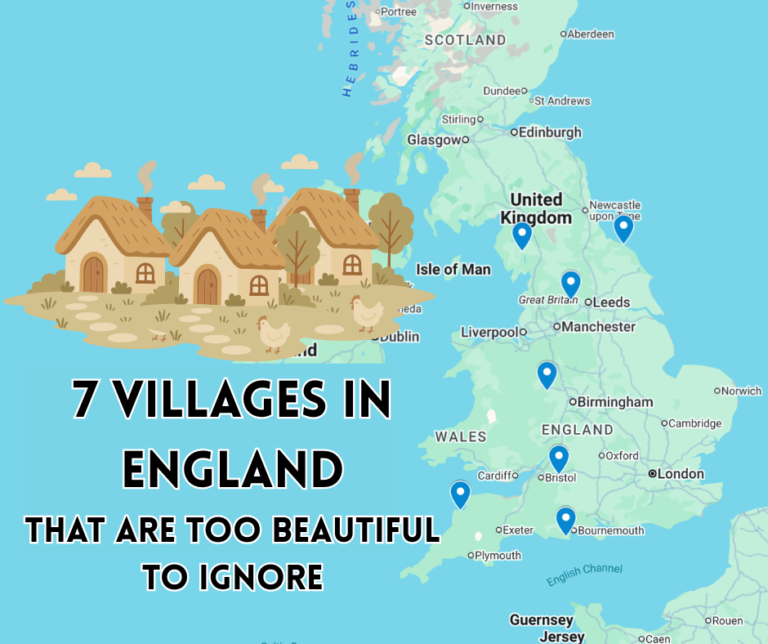
16 Beautiful Villages in the UK That Look Like They are straight out of a fairytale
Disclosure: This post may contain affiliate links, meaning I get a commission if you decide to make a purchase through my links, at no extra cost for you!
The UK is full of fairy-tale places that most people don’t even know exist.
Whether you’re after cobblestone streets, a pretty harbour, honey-coloured cottages, or just a good excuse to go for a wander with a pub lunch at the end of it — you are absolutely spoilt for choice.
Here are some of my absolute favourite beautiful villages in the UK, and trust me, every single one of them is worth the trip.
1. Robin Hood’s Bay, North Yorkshire

Robin Hood’s Bay is one of those places that just looks like it was pulled straight out of a postcard. It’s a beautiful fishing village on the Yorkshire coast with stunning sea views and some genuinely great food.
One thing to know before you go: you can’t drive into the village itself. You’ll need to park at the car park at the top and walk down from there.
It is a bit steep, so if you’re going with a pram or pushchair, just be aware — it’s much easier to carry little ones.
Once you’re down there, you’ve got cobblestone streets winding down to a really cute little harbour with a pub and a couple of places to eat.
It’s also worth knowing that Robin Hood’s Bay is the eastern end point of the famous Coast to Coast Walk (also known as Wainwright’s Coast to Coast) — a long-distance trail that crosses the whole of northern England from St Bees in Cumbria.
Even if you haven’t walked it, watching hikers arrive is a lovely moment.
It can get busy in summer, so a weekday visit is always a good shout.
2. Castle Combe, Cotswolds
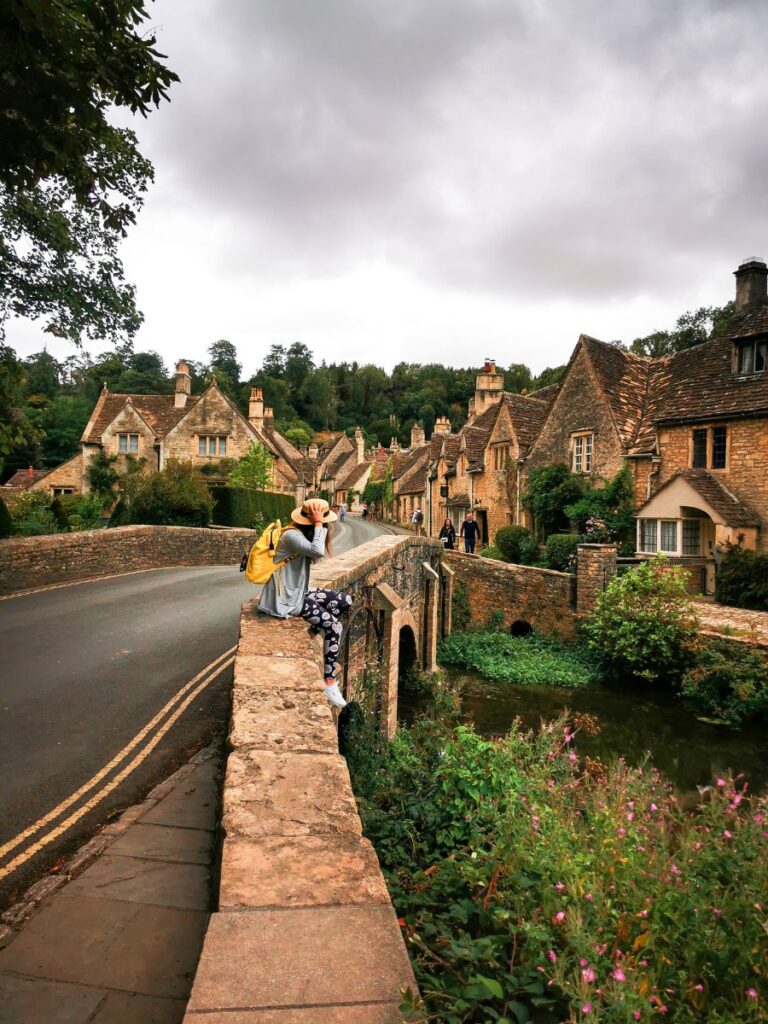
Castle Combe is widely considered the most beautiful village in England, and honestly, it’s very hard to argue with that.
It is stunning!
The rows of honey-coloured Cotswold stone cottages look like they belong in a period drama (and they have been used in quite a few, including the 1967 film Doctor Dolittle).
Like Robin Hood’s Bay, you can’t drive into the village. There’s a car park up the road, and you walk down from there — it’s worth every step.
Make sure you walk all the way down to Water Lane and cross the little stone bridge.
That view is honestly the reason people come here.
St Andrew’s Church is also beautiful and worth visiting.
When I visited there was a little house near the church where they were selling homemade cakes and coffee.
Please note that Castle Combe can get very busy, especially on weekends, so an early morning visit is always a good idea if you want a quieter, more peaceful experience.
3. Plockton, Highlands, Scotland
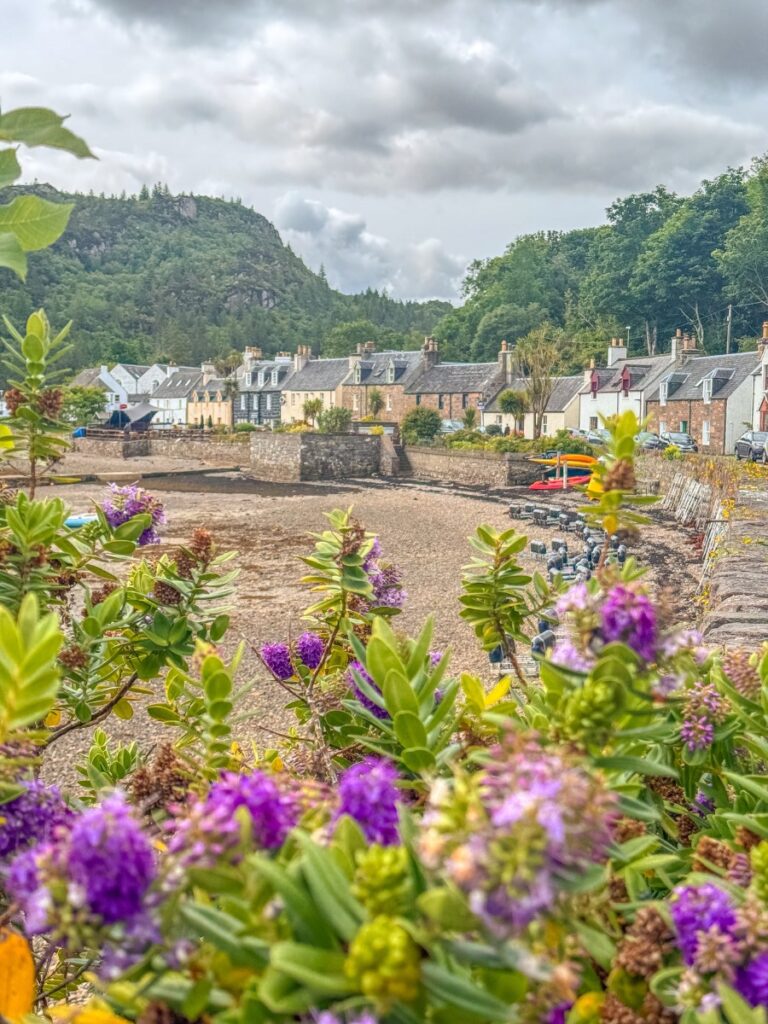
Plockton is a real hidden gem in the Scottish Highlands, and if you’re already planning a trip to the Isle of Skye or the North Coast 500, it’s absolutely worth adding to your route.
It’s a beautiful little seaside village on the shores of Loch Carron, with fewer than 500 residents, and the whole place feels wonderfully peaceful and untouched.
There’s essentially one main street that curves around the loch, lined with pretty stone cottages.
There’s also a tiny tidal island (Eilean nan Gamhainn) you can walk out to at low tide, and the views back to the village from there are gorgeous.
A couple of the pubs have outdoor terraces, and on a sunny day, sitting outside with a drink looking out over the loch and the village is just heaven.
The Plockton Hotel on Harbour Street does great food — we had an amazing lunch there and I’d highly recommend it.
Fun fact: Plockton is famous for its palm trees lining the seafront. Yes, really — palm trees in the Scottish Highlands! It also featured in the 1990s TV series Hamish Macbeth, if you remember that one.
4. Grassington, Yorkshire Dales

If you haven’t been to Grassington yet, put it on your list right now. It’s one of the prettiest villages in the Yorkshire Dales. You could easily combine a visit with nearby Kettlewell or Malham for a really lovely day out.
The village has beautiful stone houses and cottages, and a lovely market square with restaurants and cafes.
One of my favourite stops is the Stripey Badger — a charming independent bookshop with a café attached. Perfect for a browse and a bite.
At the top of the village, there’s also a quirky shop selling all sorts of sculptures and handmade items — think giraffes, unicorns, and things you absolutely didn’t know you needed.
There’s even a French patisserie, which is a fun little surprise in the heart of the Yorkshire Dales!
TV fans might also recognise Grassington as the filming location for the fictional town of Darrowby in All Creatures Great and Small (the Channel 5/PBS adaptation). The market square and streets are very recognisable from the show.
5. Pittenweem, East Neuk of Fife, Scotland

The East Neuk of Fife is a beautiful stretch of coastline between Edinburgh and St Andrews, dotted with charming little fishing villages — and Pittenweem is one of my personal favourites along the way.
It’s a small, peaceful village built around a working harbour, with the whitewashed stone cottages that are typical of this part of Scotland.
There are a couple of lovely restaurants and cafes, and you can just walk along the harbour and take it all in.
The whole place feels very calm and very pretty — exactly the kind of spot where you can slow right down and just enjoy being there.
It’s also worth knowing that Pittenweem hosts a brilliant arts festival every August, where residents and artists open their homes and studios as pop-up galleries. If you can time a visit around it, it’s a really special event.
6. Portmeirion, Gwynedd, Wales

Portmeirion is probably the most unique place on this entire list — there is genuinely nothing else quite like it in the UK.
It’s an Italian-like village on the coast of North Wales, near Snowdonia National Park, built between 1925 and 1975 by architect Sir Clough Williams-Ellis.
Walking in feels like being teleported to the Italian Riviera — colourful buildings, beautiful gardens, piazzas, and all of it just a few miles from the mountains of Snowdonia.
There is an entrance fee to get in (check the website for the latest prices), but I genuinely think it’s worth it because the place is so utterly unlike anything else you’ll see.
Once inside, you walk down through the village past all the colourful houses until you reach the main square with its gorgeous gardens and Italian-style café.
On a sunny day it’s incredible.
From there you can walk down towards the estuary, where there are a few shops selling Welsh products — seaweed, ceramics, and other lovely local things.
The further you go, the more it starts to feel like Wales again, which is a fun contrast.
Portmeirion was also the filming location for the iconic cult 1960s TV series The Prisoner, which is why you might get a strange sense of déjà vu if you’ve ever watched it!
7. Lower Slaughter, Cotswolds, England

Everyone talks about Bourton-on-the-Water and Castle Combe when it comes to the Cotswolds, but Lower Slaughter is honestly one of the most underrated villages in the whole area.
It’s smaller and quieter, which means you’ve got a much better chance of actually finding a parking spot.
The village is gorgeous — honey-coloured Cotswold stone cottages, little stone bridges, and a pretty stream running right through the middle of everything.
It’s that stream that makes it so peaceful. You can walk along the bank, cross the bridges, and take beautiful photos at every turn.
One tip: Lower Slaughter is a great starting point for a walk to neighbouring Bourton-on-the-Water, which saves you the infamous parking nightmare at Bourton.
On the way back, keep an eye out for the Hawkstone brewery — yes, that’s the one mentioned in Clarkson’s Farm.
They have a brilliant bar with hay bales and a proper farm feel, and they do brewery tours too. There is also a mural with Jeremy Clarkson and Kaleb which might be of interest if you’ve been watching the show.
8. Lacock, Wiltshire, England

Lacock has been on many a bucket list for years and I’m happy to say that it did not disappoint!
The cloisters of Lacock Abbey were used as Hogwarts in the early Harry Potter films, making it a must-visit for fans. But even if you’re not particularly into Harry Potter, there is so much more to this place than that.
Lacock Abbey (a National Trust property) is stunning, with beautiful grounds, woodland walks, and plenty of paths that are dog-friendly too — though the cloisters themselves aren’t.
If you’re a National Trust member, entry is free, and you could easily spend a couple of hours exploring.
It’s particularly beautiful in autumn when the leaves turn.
The village itself is equally lovely — old thatched and stone cottages, little pubs, and independent shops. The bakery in particular looks so wonderfully old-fashioned it feels like stepping into a fairy tale.
Lacock is also really easy to reach from Bath, Bristol, or the Cotswolds, making it a great addition to a longer trip.
9. Clovelly, North Devon, England

Clovelly is another village that charges an entrance fee, though it’s a reasonable one and absolutely worth it.
The village is built right into a cliff, and the main street — a steep, cobbled lane — tumbles all the way down to the harbour below. It’s one of the most dramatically beautiful villages in England.
Along the way down you’ll find stone cottages covered in flowers and a few pubs tucked along the lane.
Make sure you go all the way down to the harbour but bear in mind it’s quite a climb back up!
10. Mousehole, Cornwall

Mousehole is a tiny fishing village near Penzance that the writer Dylan Thomas once called it “the loveliest village in England.”
The harbour is the heart of the village, with colourful fishing boats bobbing on the water and narrow winding lanes leading off in every direction.
It’s the kind of place where you just wander — there’s no agenda, just beautiful views around every corner. There are galleries, independent shops, and a few lovely spots to eat.
One thing that surprises a lot of visitors: Mousehole is famous for its Christmas lights in December.
The whole village lights up with thousands of festive lights from early in the month, and it’s completely free to visit. It’s become one of the most magical festive events in the UK and is very much worth the trip if you’re in Cornwall at that time of year.
11. Haworth, Yorkshire
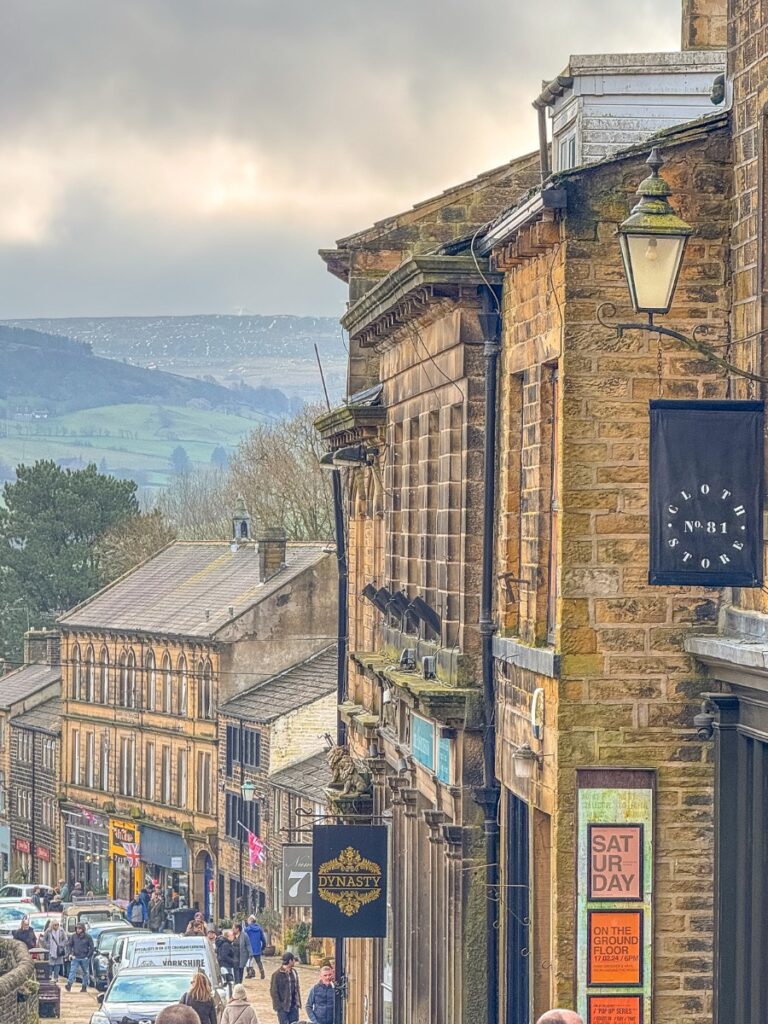
Every time I have a visitor coming to stay, Haworth is the first place I take them.
It’s one of those villages that just has it all — proper fairy-tale English atmosphere, brilliant independent shops, great food, and serious literary history.
Haworth is best known as the home of the Brontë sisters — this is where Charlotte, Emily, and Anne grew up and wrote their most famous novels.
You can visit the Brontë Parsonage Museum, walk to the Brontë Waterfall, and explore the wild moorland that inspired Wuthering Heights.
And speaking of which — if you watched the 2026 film adaptation with Margot Robbie and Jacob Elordi, this is the real-life landscape behind all of it.
Some people call Haworth the Stars Hollow of the UK (yes, like Gilmore Girls), and it kind of is — the shops are beautiful, the stone houses are gorgeous, and the whole place just has that magical, cosy atmosphere.
The best way to explore is to park at the top of the village and walk down the main street, which goes downhill with beautiful Yorkshire landscape stretching out behind you.
My personal favourite shop is the Cabinet of Curiosities — it sells bath bombs, candles, soaps, special edition books, and all sorts of beautiful, slightly witchy things.
Their seasonal decorations (especially for Halloween and Christmas) are absolutely incredible. I could genuinely spend hours in there.
12. Falkland, Fife, Scotland

Falkland makes for a brilliant day trip from Edinburgh (roughly an hour away), and it’s especially worth a visit if you’re a fan of Outlander.
The village’s main square was used in the very first episode of the series, standing in for Inverness — once you see it, you’ll recognise it instantly.
Beyond the Outlander connection, Falkland is a genuinely lovely village with a few nice cafes and pubs.
The main attraction is Falkland Palace, a beautiful Renaissance royal palace that was a favourite retreat of Mary Queen of Scots.
It’s a Historic Environment Scotland property, so if you’re a member, entry is free. The gardens alone are stunning.
13. Staithes, North Yorkshire, England
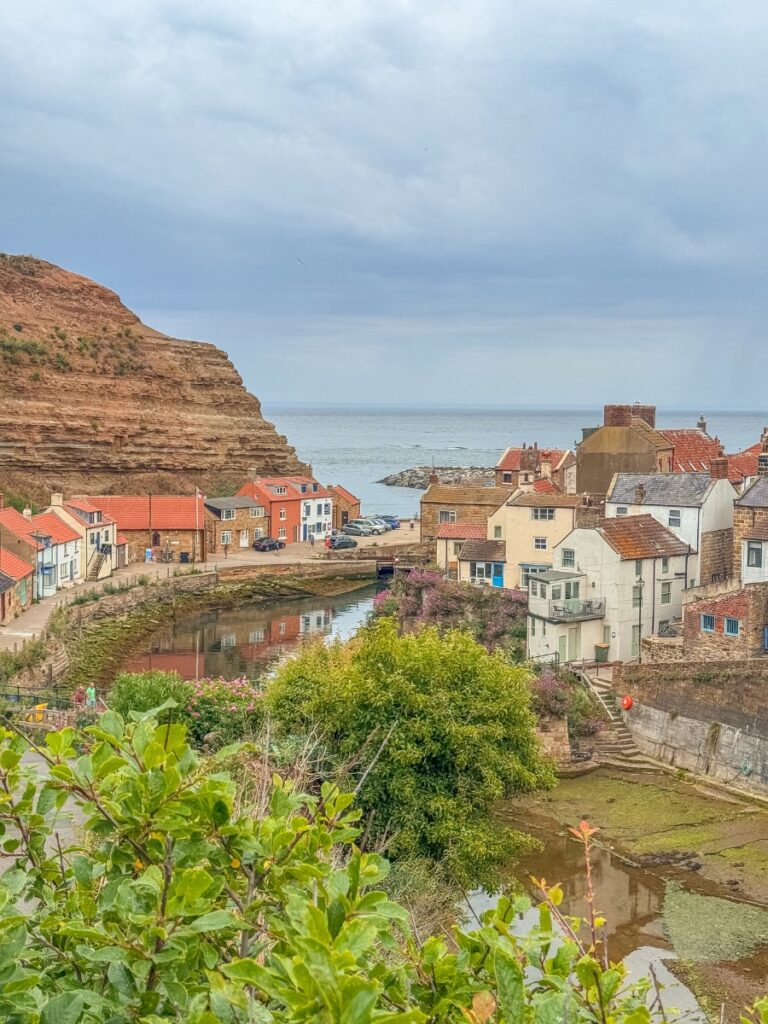
Staithes is another Yorkshire gem — a proper old-school fishing village that feels like it hasn’t changed much in centuries.
Like Robin Hood’s Bay, you can’t drive into the lower part of the village, so park at the top and walk down through the narrow streets to the harbour.
Once you’re down by the water, head to the Cod and Lobster pub right on the seafront — there’s a little beach spot just beside it that’s lovely on a sunny day.
I’d also really recommend crossing the bridge and walking up to Cowbar Bank on the other side.
The views back over the village from there are absolutely stunning and worth every step.
History fans will love knowing that a young Captain James Cook worked here as a grocer’s boy before being drawn to the sea — the rest is history.
There’s a heritage museum in the village with great information about his early life here.
14. Corfe Castle, Dorset
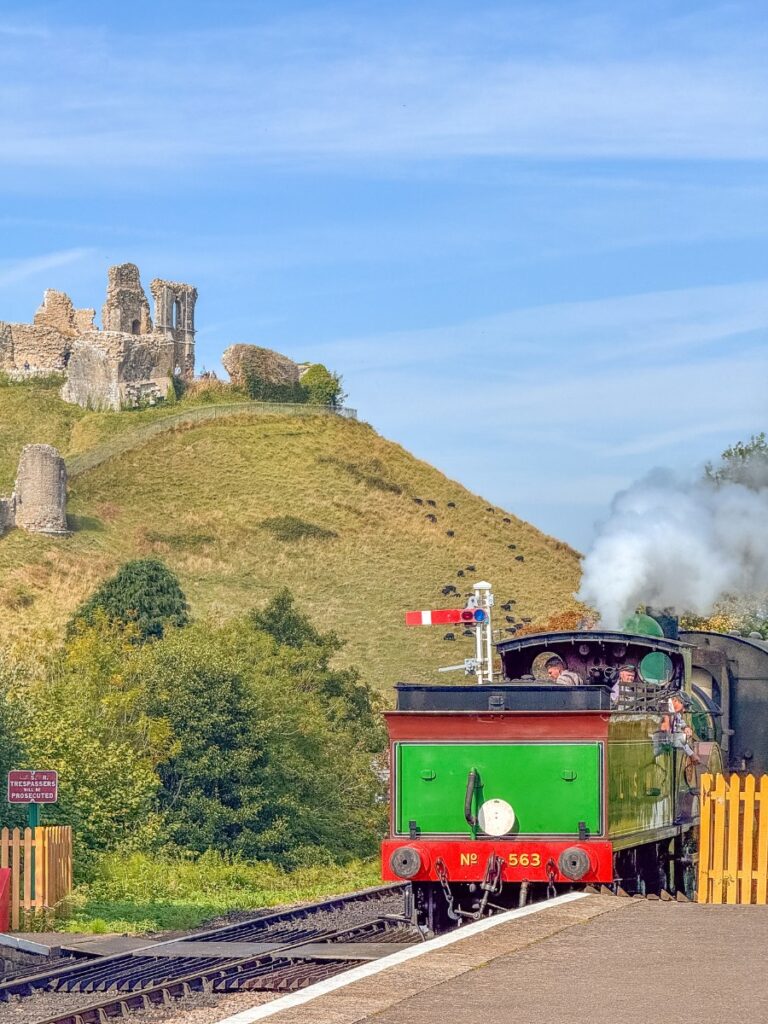
Corfe Castle is one of my absolute favourites — partly because it’s a stop on a proper heritage steam railway, and I am a total sucker for a steam train.
You can of course drive and park there, but if you want the most magical experience, take the Swanage Railway heritage steam train from Norden (where there’s a car park and ticket office).
As you approach Corfe Castle by train, you get this incredible view of the ruined castle sitting dramatically on a hill above the village.
The photos from the train are just stunning.
It’s also dog-friendly, which is always a bonus!
From the station, it’s a short walk into the village, which has a great bakery, a lovely old pub, a museum, and the National Trust shop.
The castle itself is a National Trust property — entry is free for members.
And even if you don’t want to go inside, please do stop at the National Trust café. It has an outdoor terrace at the back with direct views up to the castle — it might just be my favourite café view in the entire UK.
15. Grasmere, Lake District

Grasmere is one of the most beloved villages in the Lake District, and for good reason.
It’s set among some of the most beautiful scenery in England, and the village itself is just gorgeous — a pretty river running through, bookshops, pubs, bakeries, and lovely independent shops everywhere.
It’s closely associated with the poet William Wordsworth, who lived here at Dove Cottage (now a museum open to visitors).
But the one thing you absolutely cannot leave Grasmere without visiting is the Grasmere Gingerbread Shop, tucked right next to the church.
It’s been here since Victorian times and still uses the same original recipe created by Sarah Nelson.
The gingerbread is more of a crumbly biscuit than a cake, and it’s genuinely one of the best things you’ll eat.
I’m not even a big gingerbread fan and I still make a beeline for it every single time.
You’ll find the shop easily enough — just follow the smell.
16. St Monans, East Neuk of Fife, Scotland

St Monans is the second East Neuk of Fife village on this list, and it’s another one I really love.
It’s small and unassuming, but the harbour is just really lovely — you can wander around, watch the boats, and soak in that peaceful coastal atmosphere.
The best time to visit is around sunset, when the light hits the water and the old stone buildings in the most beautiful way.
You can also walk or drive up to St Monan’s Kirk — an ancient church that sits dramatically close to the sea — and the views from the churchyard out to sea with the village below are just wonderful.
I hope this article was helpful and if you love discovering beautiful places in the UK, here are some other articles you might be interested in: